
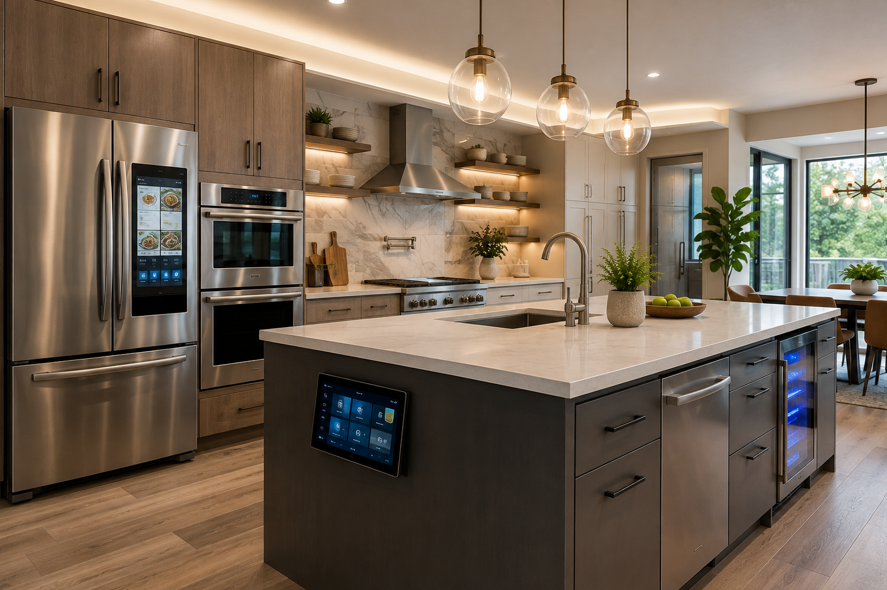
A smart kitchen in 2026 is less about filling the room with screens and more about making everyday routines easier. The strongest trends combine connected appliances, better storage, thoughtful lighting, flexible layouts, and technology that stays useful after the novelty wears off.
That shift matters for homeowners planning a remodel in Burnsville, Lakeville, Apple Valley, and across the Twin Cities. A kitchen may need to handle weekday breakfasts, meal prep, homework, entertaining, device charging, grocery storage, and family gathering without feeling crowded or overly technical.
Infinite Floors Kitchens Bathrooms works with homeowners on complete kitchen remodels as well as flooring, cabinets, countertops, and related products. That makes it possible to think about technology and layout as part of the whole room instead of adding smart features after the major design decisions have already been made.
Industry research backs up the move toward function. The National Kitchen & Bath Association’s 2026 Kitchen Trends Report describes kitchens as becoming more intelligent, personalized, health-conscious, and connected to surrounding living spaces. Houzz’s 2026 U.S. Kitchen Trends Study also found that 38% of renovating homeowners cited deterioration or poor function as a renovation trigger, putting function nearly on par with dissatisfaction with style at 41%.
The takeaway is simple: the smartest kitchen isn’t necessarily the one with the most technology. It’s the one where the layout, appliances, lighting, storage, and connected features work together.
Trend 1: Smart Appliances Are Becoming More Practical
Connected appliances have been around for years, but their role is changing. Instead of treating Wi-Fi as a headline feature, manufacturers are increasingly using connectivity to solve specific everyday problems.
At KBIS 2026, new appliance introductions included refrigerators that improve visibility and allow owners to check contents remotely, along with ovens that use built-in cameras, AI-assisted cooking features, precision modes, and app-based monitoring. The direction is toward technology that provides useful information or saves a trip back to the kitchen rather than technology added for its own sake.
Smart Refrigerators Are Moving Beyond the Door Screen
The more useful smart-refrigerator features are often the ones you barely notice. Depending on the model, these can include:
Interior cameras for checking food while away from home
Temperature and maintenance alerts
Customizable storage configurations
Remote settings through an app
Better lighting and visibility inside the cabinet
NKBA’s 2026 research found smart, spacious refrigerators gaining traction, while customizable refrigerator configurations were also highlighted as part of the broader move toward personalized kitchens.
For a remodel, the bigger decision is still physical fit. Door swing, walkway clearance, cabinet depth, ventilation requirements, and nearby counter space matter more than an app. Choose the appliance early enough in the design process that cabinetry and circulation can be planned around the actual specifications.
Trend 2: Cooking Technology Is Focusing on Precision and Convenience
Smart cooking is also moving away from gimmicks. The useful 2026 features are designed to give homeowners more control over how food cooks and how closely they need to monitor it.
NKBA’s 2026 report identifies steam cooking as a growing wellness-oriented feature, while products introduced at KBIS 2026 included ovens with cameras, assisted cooking, and remote monitoring.
Think About the Features You Will Actually Use
Potentially useful cooking features include:
Steam-assisted cooking
Guided or precision cooking modes
Built-in food monitoring
Remote oven status checks
Programmable cooking settings
Multi-function ovens that reduce the need for separate countertop appliances
A household that cooks elaborate meals several nights a week may get real value from precision features. Another family may prefer a straightforward appliance with dependable controls and fewer connected functions.
There is no prize for installing every available feature. A smart remodel starts with how you cook, what you cook, and which conveniences would genuinely improve your routine.
Plan Power, Ventilation, and Cabinetry Together
Appliance decisions can influence electrical planning, ventilation, cabinetry dimensions, and countertop layout. If a new cooking setup changes the type or location of appliances, those details belong early in the remodel conversation.
This is also where professional coordination matters. Appliance specifications can change what is needed behind the finished surfaces, so the design team and qualified trades need accurate model information before final installation work begins.
Trend 3: The Kitchen Is Being Designed in Zones
One of the biggest 2026 layout ideas has little to do with electronics.
The kitchen is becoming a collection of activity zones rather than one open room where every task competes for the same counter. NKBA’s 2026 research found strong interest in dedicated beverage areas, pet feeding stations, eat-in kitchens, mudroom connections, flex-office spaces, walk-in and butler pantries, and storage-packed islands.
Houzz found a similar pattern. In its 2026 study of U.S. renovating homeowners, 76% included specialty built-in features. Pantry cabinets were the most common at 47%, followed by beverage stations at 24%.
A Beverage Zone Can Take Pressure Off the Main Work Area
A coffee or beverage station can keep morning traffic away from the primary cooking zone. Depending on the household, it may include a coffee machine, mugs, glassware, a small refrigerator, or storage for tea and drink supplies.
The benefit isn’t the label “beverage station.” It is separating a frequent activity from the main prep area.
Pantry Zones Are Doing More Work
Pantries are also becoming more functional. Houzz found that among new or upgraded butler’s pantries, homeowners commonly added small-appliance storage, prep counters, enclosed cabinets, and appliances such as refrigerators, microwaves, and coffee machines.
For Minnesota families who want the main kitchen to stay visually calm, a pantry or secondary work zone can keep frequently used appliances accessible without leaving every appliance on display.
Trend 4: Storage Is Becoming Smarter Without Looking High-Tech
Some of the smartest kitchen upgrades contain no software at all.
Storage that places frequently used items where they belong can save more daily effort than a connected gadget. NKBA’s report points to floor-to-ceiling cabinetry, more drawers, walk-in and butler pantries, configurable refrigeration, and islands packed with storage as important directions for 2026.
A well-planned kitchen remodeling project can coordinate cabinetry, countertops, appliances, flooring, and storage so each feature supports the same daily workflow.
Drawers Are Taking on More Jobs
Deep drawers can bring cookware, dishes, and pantry products into easier reach. Specialized inserts can organize utensils, spices, trays, or food-storage containers.
Other useful ideas include:
Pull-out pantry storage
Vertical tray dividers
Appliance garages
Trash and recycling pull-outs
Charging drawers
Corner storage systems
Interior cabinet lighting
Dedicated pet-food storage
The most effective options depend on what your household owns. Before choosing organizers, take inventory. Storage works best when it is designed around real cookware, appliances, groceries, and habits rather than a showroom display.
Trend 5: Charging and Connectivity Are Becoming Less Visible
Technology is moving into the background of kitchen design.
NKBA specifically identifies embedded wireless charging, app-controlled appliances, and connected lighting as growing smart-kitchen features. At KBIS 2026, manufacturers also showed cabinetry with integrated wireless charging designed to keep devices away from visible countertop clutter.
That is a useful direction because phones and tablets are already part of kitchen life. They hold recipes, grocery lists, calendars, music, and family messages. Giving those devices a planned home can reduce cord clutter.
Think Beyond a Charger on the Counter
Possible options include:
Charging drawers
Concealed outlets inside appliance storage
Wireless charging built into suitable surfaces
A dedicated family-device zone
USB-capable outlets where appropriate
A tablet location for recipes or household planning
Electrical details need to be coordinated with qualified professionals and the products being installed. The design goal is simple: power where you use it, without letting cords dominate the finished kitchen.
Trend 6: Lighting Is Becoming Both Smarter and More Layered
Lighting is one of the clearest places where technology and design overlap.
NKBA’s 2026 report found natural lighting, overall lighting quality, and task lighting among homeowners’ highest kitchen design considerations. Under-cabinet lights, interior cabinet lights, and pendants were among the lighting types expected to remain popular.
One Lighting Layer Is Rarely Enough
A useful kitchen lighting plan may combine:
General ceiling lighting
Task lighting over preparation areas
Under-cabinet lighting
Pendant lighting
Interior cabinet lighting
Accent lighting for selected features
Connected controls can add scheduling, dimming, scenes, or app control, but those features work best when the basic lighting layout is strong.
For example, a “morning” scene might provide brighter task lighting at the coffee and prep areas, while an evening setting could lower general lighting after cooking is finished. The technology supports the room rather than becoming the focus.
Plan Lighting Before Cabinets Are Final
Under-cabinet and interior-cabinet lighting can affect wiring and cabinet details. Waiting until the cabinets are installed limits the available options.
If integrated lighting is part of the plan, bring it into the design conversation while cabinet elevations and electrical locations are still being developed.
Trend 7: Large Islands Are Becoming Multi-Purpose Work Centers
The kitchen island remains central, but the 2026 version is expected to do more than provide extra countertop space.
NKBA’s research points to storage-heavy islands as part of smarter kitchen planning, while the broader trend toward personalized, multi-purpose kitchens encourages islands to support several activities at once.
A well-designed island might provide:
Food-preparation space
Seating
Drawers and cabinet storage
A sink or appliance
Charging
Serving space
Homework or laptop space
Storage for dishes used nearby
Bigger Is Not Automatically Smarter
An island still has to fit the room.
If it blocks the refrigerator, creates tight walkways, interferes with appliance doors, or forces people through the main cooking zone, the added square footage is not improving function.
Start with circulation, then decide what the island can reasonably contain. In some kitchens, a smaller island with excellent storage is more useful than a large island overloaded with features.
Trend 8: Smart Kitchens Are Becoming More Adaptable
A remodel planned in 2026 may stay in place for many years, so adaptability has real value.
NKBA’s generational findings show different priorities across age groups, from connected homes and multifunctional living to smarter storage and easier, healthier living. The common idea is personalization.
That can translate into design decisions that work for more people over time, such as:
Easy-to-reach storage
Drawers instead of deep lower cabinets
Clear circulation paths
Multiple work surfaces
Comfortable task lighting
Flexible seating
Controls that are easy to understand
Storage that can change with household needs
Smart design is not limited to automation. A kitchen that remains comfortable as routines, family size, or mobility needs change is smart in a more lasting way.
Trend 9: Homeowners Are Hiding More Technology
The futuristic kitchen filled with glowing screens is not the only direction for 2026. In many designs, the technology is becoming less visually dominant.
NKBA reports growing interest in panel-faced refrigerators and dishwashers as part of a broader movement toward minimal, integrated kitchens. Houzz’s coverage of KBIS 2026 similarly describes technology taking a lighter-touch approach, with advanced functions integrated into products rather than making every appliance look like a computer.
That creates an appealing balance: modern capability with a warm, residential feel.
A connected oven can still sit within classic cabinetry. Wireless charging can disappear into a drawer. A refrigerator can have advanced internal features while using a panel that coordinates with surrounding cabinets.
For homeowners who worry that smart technology will make a kitchen feel cold or overly modern, this is one of the most useful trends to watch.
How to Decide Which Smart-Kitchen Trends Are Worth It
Trends can provide ideas, but a remodel works best when the final decisions reflect your own household.
Before choosing a smart appliance or built-in feature, ask a few practical questions.
Does It Solve a Real Problem?
If your family constantly crowds around the coffee maker, a beverage zone may make sense. If devices pile up near the island, concealed charging may help. If you regularly wonder whether the oven was turned off, remote monitoring may offer useful peace of mind.
A feature with no clear job is easier to skip.
Will It Still Work Well Without the App?
Connected products can depend on software, Wi-Fi, accounts, and manufacturer support. Look at the appliance’s core operation as well as its connected features.
A reliable oven, refrigerator, or lighting system still needs to function well as an appliance or fixture first.
Does It Fit the Entire Remodel?
The best smart feature can become a poor choice if it compromises storage, circulation, cabinetry, or other priorities.
Review appliance dimensions, power needs, ventilation, counter space, cabinet clearances, and flooring transitions together before finalizing the plan.
Build a Smarter Kitchen Around the Way You Live
The biggest smart-kitchen trend of 2026 isn’t a single appliance. It is integration.
Appliances are becoming more connected and precise. Storage is becoming more personalized. Lighting is layered and controllable. Islands are doing more work. Pantries and beverage zones are taking pressure off the main kitchen. Charging is disappearing into cabinetry, and advanced technology is increasingly designed to blend into the room.
The strongest remodels connect those ideas instead of collecting them.
For homeowners in Burnsville, Lakeville, and Apple Valley, that could mean a kitchen with a better prep zone, a pantry that hides countertop appliances, a refrigerator configured around family grocery habits, layered lighting for dark Minnesota evenings, and a few connected features that genuinely save time.
Infinite Floors Kitchens Bathrooms offers complete kitchen remodeling alongside flooring, cabinets, countertops, and related products, giving homeowners a way to plan the surfaces, storage, and overall room together. The business has served the Twin Cities market since 2015 and describes its team as coming from an installer background.
If you’re planning a 2026 kitchen update and want to turn smart ideas into a practical layout, reach out to us to discuss your space, priorities, and remodeling goals.



