

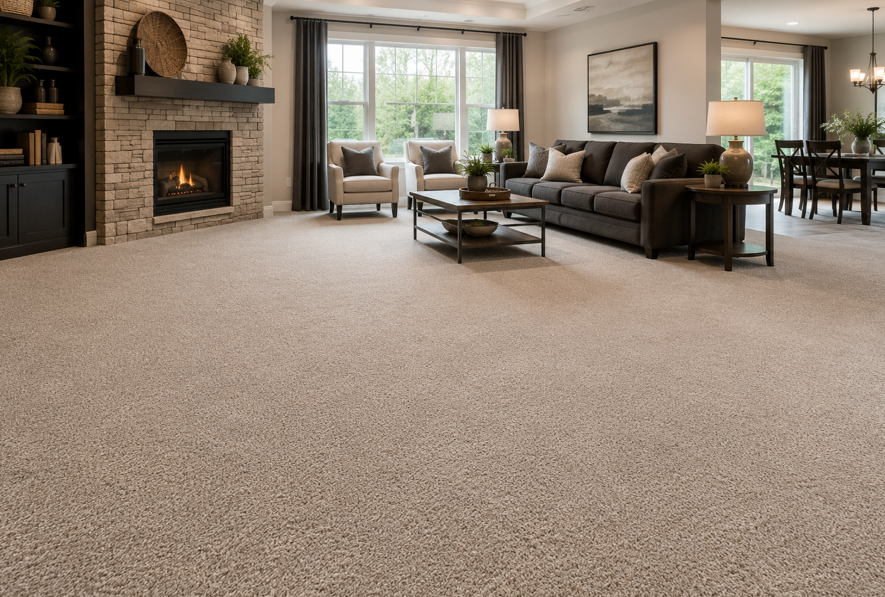
Large rooms can make a home feel open, comfortable, and inviting, but carpeting them comes with one practical challenge many homeowners do not think about until installation day: seams.
Most carpet is manufactured in standard widths, which means a wide family room, finished basement, great room, or open-plan living space may need more than one piece of carpet. When two pieces meet, installers create a seam.
A professional installation can make seams neat and far less noticeable, but no installer can guarantee that every seam will be completely invisible in every room. Carpet construction, lighting, traffic patterns, installation direction, and room dimensions all influence how noticeable a seam becomes.
For Burnsville homeowners, understanding those factors before choosing carpet can make a big difference. Infinite Floors Kitchens Bathrooms works with homeowners across Burnsville, Lakeville, Apple Valley, and the surrounding Twin Cities area to help match flooring products and installation plans to the realities of each space.
If you have a large room to carpet, the goal is not to pretend seams do not exist. The goal is to choose the right carpet, plan seam placement carefully, and use professional installation techniques that help those seams blend naturally into the finished floor.
Why Large Rooms Often Need Carpet Seams
Carpet is produced in rolls rather than in custom widths for every room. When the width or shape of a room exceeds the available carpet width, multiple sections may be needed to cover the floor.
That is common in spaces such as:
Large family rooms
Finished basements
Open-concept living areas
Great rooms
Long bedrooms
Rooms with alcoves or unusual shapes
Spaces that connect to hallways or adjoining carpeted areas
A seam simply joins two carpet sections together so the flooring can cover the entire area.
The important point is that having a seam does not automatically mean anything went wrong. In many large carpet installations, seams are a normal part of the project.
A well-planned seam has tightly joined edges, proper preparation, and placement that takes the room into account. The installer also balances seam visibility with material efficiency. Trying to eliminate every seam can sometimes require significantly more carpet, which may add unnecessary material to the project.
Before ordering, homeowners benefit from discussing room measurements, furniture placement, windows, traffic flow, and carpet construction with the installer. Those details help determine where seams are likely to fall and how visible they may be.
When choosing flooring for a large room, Infinite Floors Kitchens Bathrooms can help Burnsville homeowners look at both the carpet itself and how it will work within the complete space.
Choose a Carpet Style That Helps Seams Blend In
One of the biggest factors affecting seam visibility is the carpet you choose.
Some styles naturally disguise seams better than others because their fibers and surface texture break up the visual line where two pieces meet.
Textured Carpet Can Be More Forgiving
Carpets with more texture can often help seams blend into the surrounding surface.
The variation in the pile makes the floor less visually uniform, which can make a seam harder to spot from normal standing height.
Frieze-style carpets, for example, use twisted fibers that create a textured appearance. Because those fibers do not sit in one perfectly smooth direction, a seam may attract less attention than it would in a lower-profile carpet.
Low-Profile Styles Can Show Seams More Easily
Lower-profile carpets can make seams more noticeable because there is less pile available to disguise the join.
Looped carpets, including some Berber-style products, can reveal seams more easily depending on the pattern and construction.
The same can apply to tightly constructed plush or Saxony styles where differences in pile direction or compression become visible in certain lighting.
Patterned carpets create another consideration. Even when the seam itself is well constructed, the pattern needs to align correctly where the two sections meet.
Softness and Seam Visibility Are Different Questions
It is easy to choose carpet based mainly on how soft it feels in a showroom, but softness does not tell you how successfully it will disguise seams.
For a large Burnsville living room or basement, homeowners may want to compare comfort, texture, durability, and seam visibility together rather than treating them as separate decisions.
Tell the flooring professional early if minimizing visible seams is one of your main priorities. That information can help narrow the choices before the room is measured and the installation plan is created.
Plan Seam Placement Around How You Use the Room
Where the seam sits can matter almost as much as the carpet style.
A thoughtful installer looks at the entire room rather than simply finding the shortest way to connect two pieces.
Consider the Main Viewing Angles
Think about where people usually see the room from.
A seam running directly through the most prominent sightline may attract more attention than one positioned in a less obvious part of the floor.
For example, homeowners might commonly view a family room from:
The main doorway
A kitchen opening
A staircase
A hallway
A seating area
An adjacent room
Those viewing angles can help inform seam placement.
Think About Furniture Placement
Furniture can make some areas of the floor less visually prominent.
That does not mean the installation needs to hide every seam beneath furniture. Large pieces may move later, and the seam still needs to be properly constructed.
However, understanding the likely furniture layout gives the installer useful context.
A seam that runs through the middle of a major open walkway may receive more attention and traffic than one located in a quieter part of the space.
Keep Heavy Traffic in Mind
Repeated foot traffic can influence how carpet looks over time.
A seam located in a heavily travelled pathway may experience more repeated pressure than one outside the main traffic flow. Whenever the room layout allows, installers can consider these traffic patterns while planning the carpet layout.
This is particularly useful in open Minnesota homes where one large carpeted space may connect several areas together.
Good seam placement combines room dimensions, carpet width, viewing angles, traffic patterns, and efficient use of material.
Pay Attention to Carpet Direction
Carpet has direction, even when the surface initially looks uniform.
The pile tends to lie a certain way, and light reflects differently depending on that direction. If two sections are installed with different pile orientations, the sections can appear to be slightly different shades even when they came from the same carpet.
That visual difference can draw attention directly to the seam.
Professional installation planning accounts for pile direction so adjoining pieces work together visually.
This becomes especially important in large rooms where sunlight enters through several windows or sliding doors. Minnesota homes can experience dramatic differences in natural light throughout the day and across seasons, so pile direction can affect how the floor looks from morning through evening.
Homeowners do not need to calculate carpet direction themselves. It is simply useful to understand why an installer may recommend laying carpet a certain way even when another arrangement appears to use the room dimensions differently.
The installation plan is not only about covering the floor. It is also about helping the completed carpet look consistent across the space.
Understand How Lighting Affects Seam Visibility
Have you ever noticed how a carpet looks different when you walk from one side of the room to the other?
Light is often the reason.
Natural and artificial lighting can make subtle differences in carpet texture more noticeable. A seam that looks almost invisible from one angle may become more apparent from another.
Strong light coming across the floor can highlight changes in pile direction or texture. Large windows can make this particularly noticeable in spacious living rooms.
Before installation, consider where the strongest light enters the room.
Common sources include:
Large picture windows
Patio doors
Floor-to-ceiling windows
Recessed lighting
Directional lamps
Pendant fixtures in open-plan spaces
Installers can use this information when planning the carpet direction and seam layout.
Window treatments can also change how noticeable seams appear throughout the day. The point is not to hide the floor in dim lighting. It is to recognise that the same properly installed seam can look different depending on how light moves across the carpet.
When comparing carpet flooring, looking at larger samples under the lighting conditions in your own home can provide a more realistic idea of how texture and pile direction will appear after installation.
Make Sure the Carpet Comes From the Same Dye Lot
Seam planning starts before installation.
When two carpet sections will sit next to each other, homeowners generally want them to come from the same dye lot whenever possible.
A dye lot refers to a particular manufacturing run. Small shade variations can occur between separate runs because carpet coloring cannot always be duplicated with complete visual precision.
That means two rolls carrying the same manufacturer, style, and color name may still have a subtle shade difference if they were produced in different dye lots.
In a large room, that difference can make the line between sections more noticeable.
Ordering enough carpet for the entire project at one time can help reduce that concern. If several connected rooms are being carpeted, discuss them as one project rather than assuming additional carpet purchased months later will match perfectly.
It is also helpful to keep the carpet information after installation, including the manufacturer, collection, style, and color.
If you ever need matching material for a repair or future room, those details give your flooring professional useful information to work from.
Dye lot planning cannot make every seam disappear, but consistent color across adjoining carpet sections supports a more cohesive finished appearance.
Professional Seam Construction Matters
Carpet choice and seam location are important, but installation quality brings everything together.
A properly constructed seam needs carefully prepared edges that meet securely without unnecessary gaps or overlaps.
The goal is a clean, stable join that works with the carpet's construction.
Professional installers consider several details, including:
Accurate carpet cutting
Proper edge preparation
Secure seam construction
Carpet direction
Pattern alignment when applicable
Appropriate placement within the room
Balance between material use and seam quantity
The seam also needs to remain structurally sound after normal household use.
This is one reason professional installation can make such a noticeable difference in large rooms. Carpet installation is not simply rolling material across the floor and trimming the edges. Large spaces require planning before the first section is positioned.
Infinite Floors Kitchens Bathrooms states that it uses professional installers and focuses on completing projects in a timely, neat, and orderly manner. For carpet installations, the company handles product ordering and scheduling, which keeps product selection and installation planning connected.
A good installer can also explain seam expectations before work begins.
That conversation is valuable because it replaces unrealistic promises with a clear understanding of what the selected carpet and room layout are likely to produce.
Avoid Expecting Every Seam to Be Invisible
This may be the most important point for any homeowner carpeting a large room.
A properly installed carpet seam may still be visible.
That does not automatically indicate poor workmanship.
The Carpet and Rug Institute seam guidance included in Infinite Floors Kitchens Bathrooms' customer information notes that a properly constructed seam will not necessarily be invisible. The company's own guidance also explains that joining two pieces of material naturally creates the possibility of seeing where those pieces meet.
Instead of judging a seam only by whether you can see it, look at the quality of the installation.
A properly completed seam generally has:
Cleanly prepared edges
Secure edge treatment
Closely joined carpet sections
No unnecessary gaps
No overlapping edges
Reasonable pattern matching when the carpet has a pattern
Visibility can still change depending on carpet style, light, traffic, and viewing angle.
This distinction matters because homeowners sometimes choose a carpet they love and then become concerned when a seam becomes visible in strong afternoon light.
Knowing what to expect from the beginning makes it much easier to evaluate the finished project fairly.
The goal is professional seam construction and thoughtful placement, not an unrealistic promise that every join will disappear under every lighting condition.
Keep the Carpet Looking Consistent After Installation
Once the carpet is installed, routine care can help preserve an even appearance across the room.
Vacuum regularly, particularly in the areas that receive the most traffic. Dirt can affect the way carpet fibers sit and reflect light, which may make some areas look different from others.
At the same time, use a vacuum that suits your carpet.
More suction is not automatically better. Certain softer or longer-pile carpets can benefit from different vacuum settings, and some styles may be better suited to suction-only cleaning rather than aggressive beater-bar action.
Follow the carpet manufacturer's care guidance whenever possible.
Professional cleaning also plays a role. Manufacturers commonly provide specific maintenance requirements, and following those recommendations can help protect both appearance and applicable warranty coverage.
If a seam begins to concern you after installation, avoid pulling at fibers, cutting material, or attempting an improvised repair.
Contact the flooring professional instead.
A small issue can often be evaluated much more effectively when the installer can see what is happening in the room, including lighting, traffic, and the condition of the surrounding carpet.
Consistent care across the entire floor helps the seam remain part of the carpet rather than becoming the feature your eye notices first.
Get Better Results by Planning Seams Before Installation Day
Seams are a normal consideration when installing carpet in large rooms. The difference between a seam that blends naturally and one that attracts attention often comes down to decisions made well before installation begins.
Choose carpet with seam visibility in mind. Consider texture and pile construction rather than selecting by color alone. Talk through room dimensions, natural light, furniture placement, traffic flow, and major viewing angles with the installer.
Keep pile direction consistent. Whenever possible, use carpet from the same dye lot across connected sections. Most importantly, work with installers who know how to prepare, position, and construct seams properly.
For Burnsville homeowners, realistic expectations matter too. Even excellent seams can remain visible in certain carpet styles or lighting conditions. A seam does not have to disappear completely to be well installed.
The right goal is a beautiful, durable carpet installation in which seams are thoughtfully planned and professionally finished.
If you are considering carpet for a large living room, basement, bedroom, or another space in Burnsville, Lakeville, Apple Valley, or the surrounding Twin Cities area, get in touch to discuss your room, carpet options, and installation needs.



